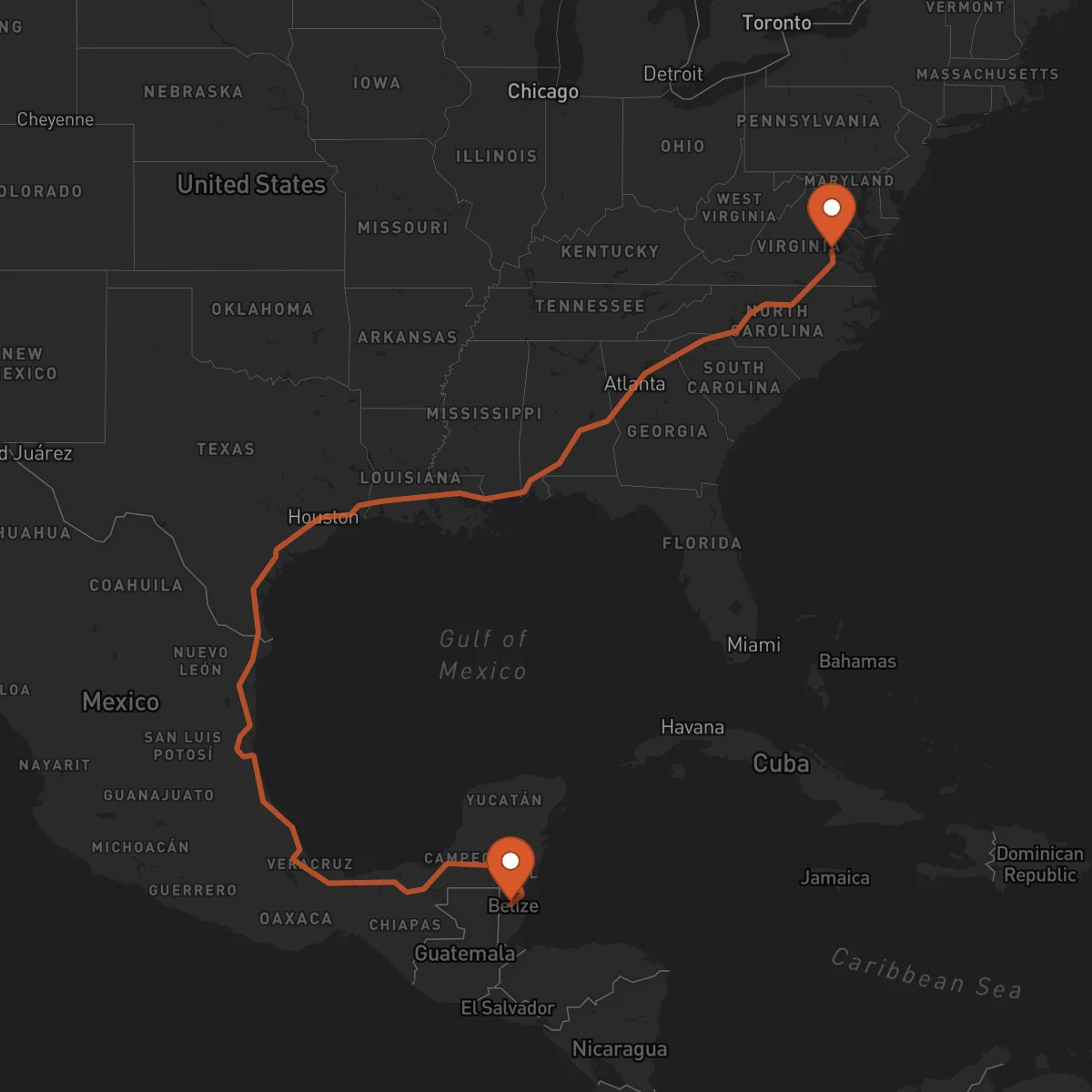
Belmopan to Richmond
Richmond → BelmopanFTL freight transportation service between Belmopan and Richmond. Reliable logistics solutions for your business.
Route Description
Everything you need to know about the corridor Belmopan - Richmond
The Belmopán, Belize to Richmond, Virginia corridor is a critical north-south artery connecting Central America with the industrial and consumer hubs of the U.S. East Coast. This cross-border route traverses diverse landscapes and economic zones, serving as a vital link for trade between Belize and the Mid-Atlantic region of the United States. Strategically, it enables the efficient movement of goods from a key Central American production and export center into one of the most significant distribution corridors in the U.S., with Richmond acting as a major logistics gateway to the Northeast and Southeast.
Economically, this corridor supports a robust flow of goods driven by complementary industrial strengths. Belize's economy relies heavily on agriculture, agro-industry, forestry products, and increasingly, light manufacturing. The U.S. side, particularly Virginia, is a powerhouse for industries such as food and beverage processing, pharmaceuticals, chemicals, paper and packaging, and advanced manufacturing. The corridor facilitates the export of Belizean raw materials and value-added products northward, while supporting the inbound flow of U.S. manufactured goods, machinery, and consumer products into Belize and the wider Central American market.
Key industries utilizing this lane include agricultural processors (citrus, bananas, seafood), timber and furniture manufacturers, chemical distributors, and food & beverage companies requiring refrigerated transport. The primary transportation infrastructure follows a logical sequence: the George Price Highway (Belize) connects to the Pan-American Highway through Mexico. The main route then utilizes Mexican Federal Highway 180 and 190 before crossing the border. In the U.S., the corridor heavily relies on the interstate system, primarily I-35 through Texas, transitioning to I-20 for the eastern leg into Virginia. The most significant and efficient border crossing for this corridor is the Hidalgo/Pharr International Bridge between Mexico and Texas, a critical node for northbound freight.
Customs and border considerations are paramount. Shipments must comply with U.S. Customs and Border Protection (CBP) regulations, including the requirement for advanced electronic manifest submission (ACE). The use of certified carriers with C-TPAT (Customs-Trade Partnership Against Terrorism) and FAST (Free and Secure Trade) credentials is essential for expedited clearance at the border, reducing wait times and enhancing security. Control Terrestre facilitates seamless operations on this corridor by leveraging its alliance of experienced providers who hold these vital certifications. We manage the entire cross-border complexity, from door pickup in Belmopán to final delivery in Richmond, ensuring compliance, security, and reliability. Our expertise in coordinating dedicated and specialized equipment—from dry vans and reefers for agricultural and food products to flatbeds for oversized industrial goods—tailors solutions to the specific needs of the corridor's primary cargo flows.
Services for this Route
Available services for the corridor Belmopan - Richmond
 Origin
Belmopán, the capital of Belize, serves as a strategic inland logistics hub for the country. Its central location within Belize provides efficient access to the nation's primary agricultural and industrial regions, including the fertile valleys of the west and the coastal production areas. The city is well-connected via the George Price Highway, the main east-west artery that links directly to the border with Mexico to the west and the port of Belize City to the east. This positioning makes it an ideal consolidation point for exports destined for North America. Key economic sectors driving outbound freight from the Belmopán area include citrus processing, banana and tropical fruit agriculture, seafood harvesting and processing, forestry products (such as lumber and furniture), and a growing light manufacturing sector producing garments and food products. The available infrastructure supports standard containerized and bulk road transport, with facilities capable of handling dry, refrigerated, and some specialized cargo types for export.
 Destination
Richmond
Richmond, Virginia, is a major strategic logistics and distribution center for the U.S. East Coast. Its location at the intersection of I-95 and I-64 provides unparalleled connectivity to the Northeast megalopolis (Washington D.C., Baltimore, Philadelphia, New York), the Southeast, and the Midwest via I-81. The city is a critical node in the national supply chain, home to extensive warehousing, distribution centers, and intermodal facilities. Richmond's economy is diverse and robust, with dominant industries including food and beverage manufacturing (a major hub for companies like Kraft Heinz, Altria), pharmaceuticals and life sciences, chemicals, paper and packaging, and advanced manufacturing. The Port of Virginia, with its deep-water terminals in nearby Hampton Roads, is one of the largest on the East Coast, facilitating significant import/export volumes. The transportation infrastructure is world-class, featuring a dense network of interstates, rail lines from major Class I railroads, and proximity to international airports, making it an optimal final destination for a wide array of goods.










