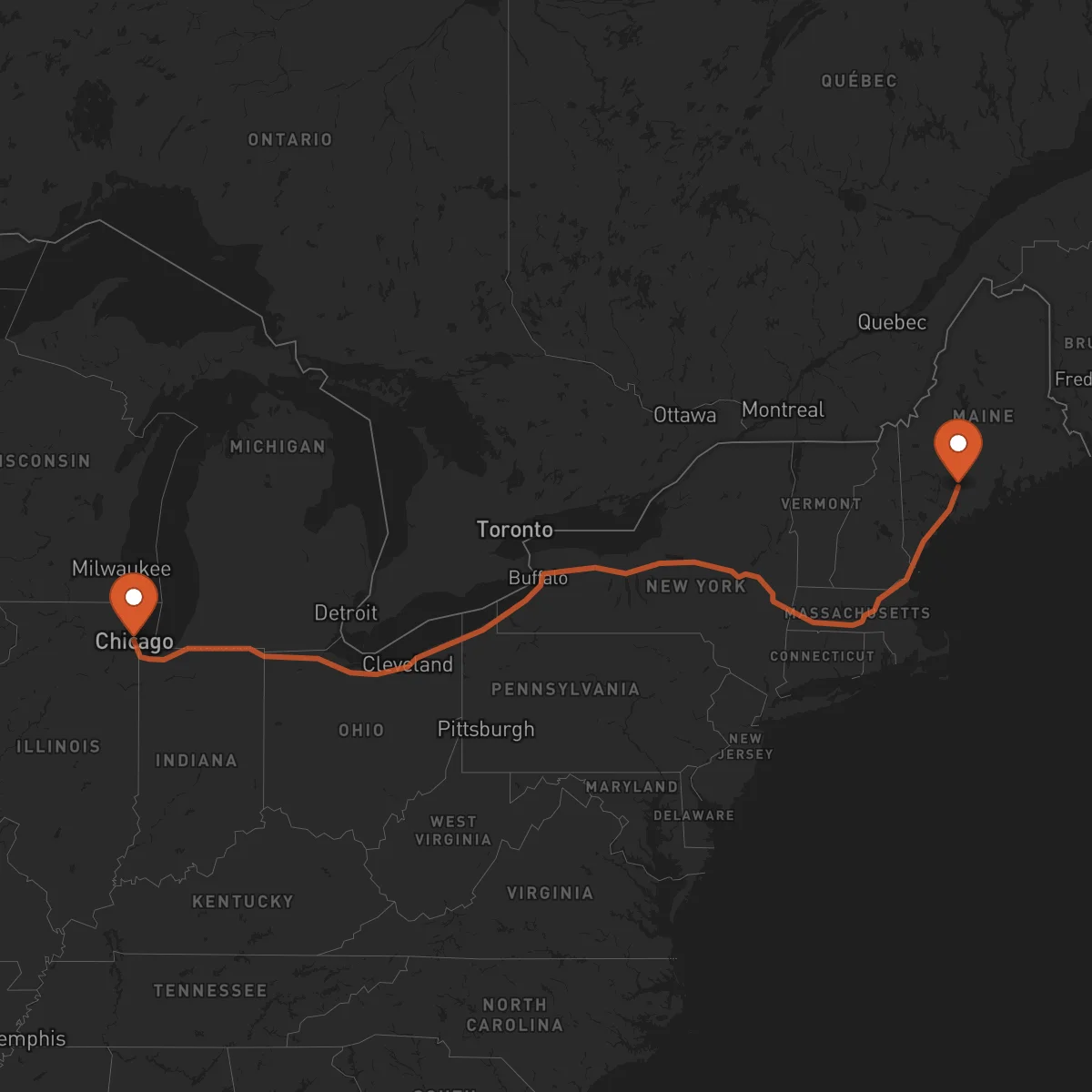
Augusta to Chicago
Chicago → AugustaFTL freight transportation service between Augusta and Chicago. Reliable logistics solutions for your business.
Route Description
Everything you need to know about the corridor Augusta - Chicago
The Augusta to Chicago corridor represents a vital logistics connection between the northeastern United States and the Midwest's economic powerhouse. This 1472 km route traverses diverse landscapes and connects two distinct economic regions, facilitating the movement of goods essential to both local and national supply chains. The corridor serves as a critical artery for businesses requiring reliable full truckload transportation between Maine's industrial base and Chicago's massive distribution networks.
The economic significance of this route extends beyond simple transportation. Augusta, as Maine's capital, serves as a gateway for the state's manufacturing and agricultural products, while Chicago stands as a global logistics hub with its strategic location at the crossroads of major interstate highways. The corridor benefits from robust infrastructure, primarily utilizing I-90 and I-95, which provide efficient north-south and east-west connectivity across the northeastern United States.
Control Terrestre enhances this corridor's efficiency through our specialized FTL services, ensuring that your cargo moves seamlessly from origin to destination. Our experienced network of transportation providers understands the unique challenges of this route, from navigating seasonal weather variations to optimizing delivery schedules across different time zones. We provide dedicated full truckload solutions that eliminate the risks associated with consolidated freight, ensuring your shipments arrive intact and on schedule.
Services for this Route
Available services for the corridor Augusta - Chicago
 Origin
Augusta
Augusta, Maine serves as a strategic logistics gateway to the northeastern United States, offering unique advantages for freight transportation. Located along the Kennebec River, Augusta provides access to both road and potential water-based logistics solutions. The city's economy centers around government services, healthcare, and manufacturing, with a growing emphasis on technology and renewable energy sectors. Augusta's proximity to major ports and its position as Maine's capital make it an ideal origin point for diverse freight shipments requiring reliable transportation to major markets.
The transportation infrastructure in Augusta includes direct access to Interstate 95, providing seamless connectivity to the broader interstate highway system. The city's location allows for efficient distribution of Maine's key products, including paper products, seafood, agricultural goods, and manufactured items. Augusta's transportation network is well-developed, with multiple freight carriers operating in the region and excellent connections to major logistics hubs throughout the northeastern United States.
 Destination
Chicago
Chicago, Illinois stands as one of North America's premier logistics and transportation hubs, offering unparalleled connectivity and infrastructure for freight movement. The city's strategic location at the intersection of major interstate highways, rail networks, and proximity to major waterways makes it an ideal destination for full truckload freight. Chicago's economy is diverse and robust, encompassing manufacturing, finance, technology, and particularly logistics and distribution services. The metropolitan area hosts numerous Fortune 500 companies and serves as a critical distribution center for goods throughout the Midwest and beyond.
The transportation infrastructure in Chicago is world-class, featuring extensive highway networks including I-90, I-94, and I-55, which provide immediate access to major markets across the United States. Chicago's O'Hare International Airport and extensive rail yards further enhance its logistics capabilities, making it a natural convergence point for supply chain operations. The city's central location allows for efficient distribution to both coastal regions and inland markets, typically within 24-48 hours, making it an essential node in national freight transportation networks.










