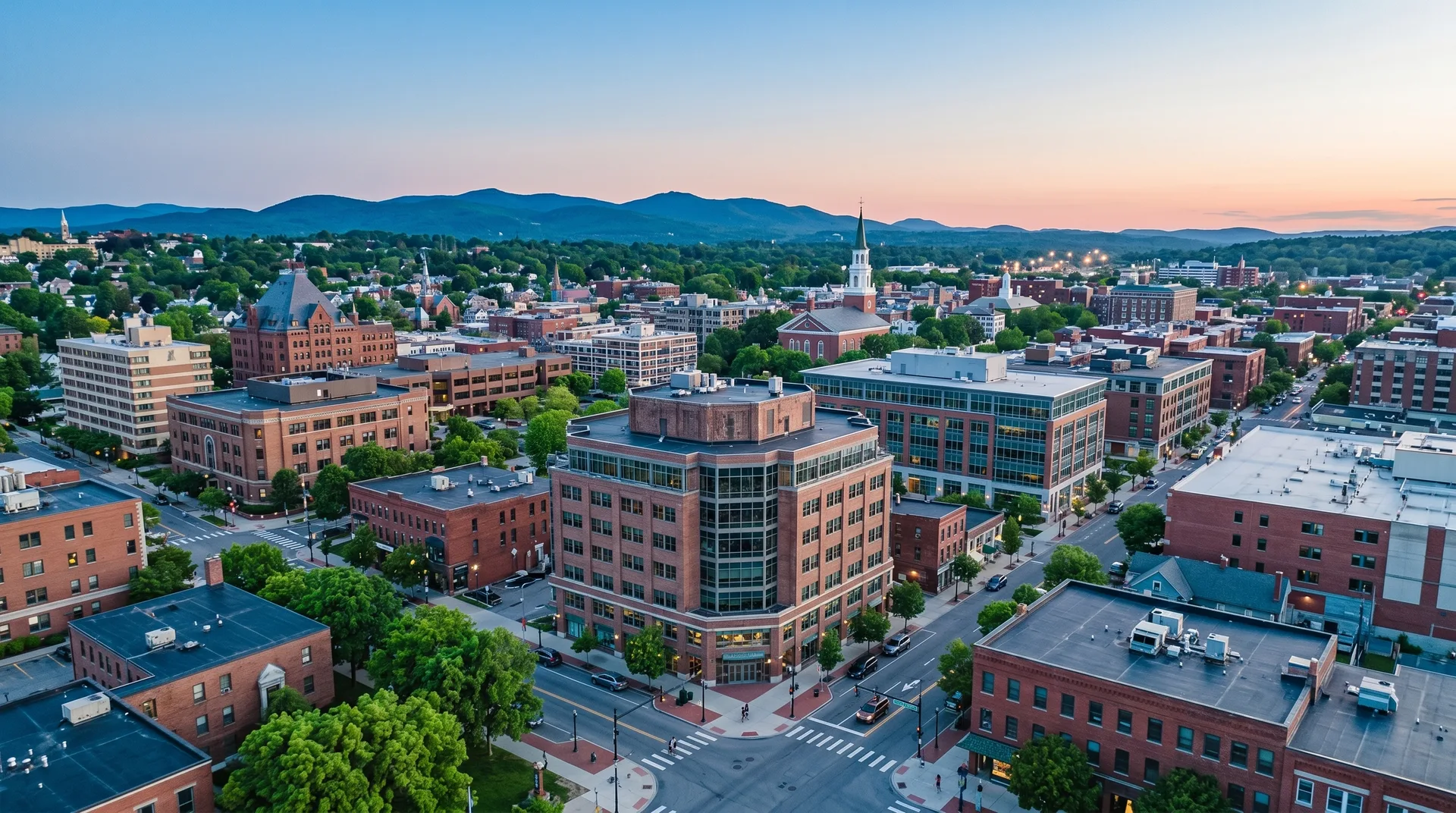

FTL freight in these cities of Vermont
Ground freight transportation in Vermont: connectivity with Quebec and agri-industrial specialization
Vermont represents a specialized logistics market in the northeastern United States, characterized by its border location with the province of Quebec, Canada, and an economy oriented toward high-value-added sectors such as processed foods, precision manufacturing, and specialty products. With a population concentrated along the corridor connecting Burlington with Rutland and areas near the Canadian border, the state serves as a transit point for trade between Montreal and northeastern U.S. markets. From Control Terrestre, we operate in Vermont recognizing the particularities of this market, where the dairy industry, specialty food production, and precision manufacturing demand transportation services tailored to specific volumes and strict quality requirements.
Vermont's mountainous topography and winter weather conditions present operational challenges that require local experience and detailed knowledge of routes, seasonal restrictions, and best practices to maintain service continuity.
Infrastructure and connectivity
Vermont has a highway network that connects the state to major northeastern markets and facilitates cross-border trade with Canada. Interstate 89 (I-89) is the state's main highway, running through Vermont from southeast to northwest and connecting the White River Junction area with Burlington and continuing toward Montreal, Quebec. This route is essential for trade with Canada and for connecting Vermont with New Hampshire and Massachusetts.
Interstate 91 (I-91) runs through Vermont from south to north along the Connecticut River valley, connecting the Massachusetts border in the south with the Canadian border in the north. This highway links Vermont with Connecticut, Massachusetts, and Quebec, facilitating the movement of freight to urban markets in the Northeast.
U.S. Route 7 is a federal highway that runs through Vermont from south to north, passing through Bennington, Rutland, and Burlington. Although it is not an interstate, it is important for access to communities and industrial zones that are not directly on the I-89 and I-91 corridors.
Vermont has several border crossings with Canada, the most important being Derby Line-Stanstead, Highgate Springs-Philipsburg (near Burlington), and Beecher Falls-East Hereford. These crossings facilitate trade with Quebec, especially important for the manufacturing and agri-industry sectors that operate integrated supply chains between Vermont and the Canadian province.
Burlington, Vermont's largest city, serves as the state's main economic and logistics hub, with access to Lake Champlain providing limited waterborne transportation connectivity to the state of New York and, through the canal system, to the St. Lawrence River.
Winter conditions in Vermont, with significant snowfall and below-freezing temperatures, are an operational factor that our carriers consider in route planning and delivery scheduling, especially in mountainous and rural areas.
Industries and key sectors
The dairy industry is Vermont's most important agricultural sector, with the state being recognized for its high-quality dairy products. The production of milk, artisanal and specialty cheeses, yogurt, and other dairy derivatives generates constant demand for refrigerated transportation from processing facilities to regional markets in the Northeast. Vermont is home to over one thousand dairy farms that supply local and regional processors.
Maple syrup production is emblematic of Vermont, as the state is the largest producer in the United States. The transportation of maple syrup, maple sugar, and derivative products to domestic and international markets is seasonal but significant.
Specialty food manufacturing includes craft beer production, organic products, natural foods, chocolates, and gourmet products. Vermont has developed a reputation for quality in this segment, with products distributed to premium markets across the country. Transporting these products frequently requires careful handling and controlled conditions.
Precision manufacturing includes the production of electronic components, medical devices, scientific instruments, and specialized equipment. Although the sector is relatively small, it generates high-value freight that requires reliable and frequently expedited transportation.
The forestry and wood products industry maintains a presence in Vermont, with production of lumber, furniture, and forest products. Transporting these materials requires appropriate equipment and knowledge of access routes to forested areas.
The beverage sector, especially craft beer and cider, has experienced growth, with Vermont being recognized for its craft producers. Distributing these products to markets in the Northeast and beyond generates regular movements of refrigerated and dry freight.
Our solutions for Vermont
At Control Terrestre, we operate in Vermont with domestic ground transportation services connecting the state to all regions of the United States, as well as cross-border transportation to Canada, especially Quebec. Vermont's position on our northeastern routes allows us to offer efficient connectivity to the region's major urban centers.
For the dairy and processed food industries, we provide refrigerated transportation using 48' and 53' units that maintain the required temperature ranges for perishable products such as dairy, meat products, prepared foods, and beverages. Our carriers with Transporte Limpio certification ensure proper handling of food products under the quality standards demanded by this sector.
For specialty foods and high-value products such as artisanal cheeses, organic products, and maple syrup, we operate with equipment that provides adequate protection and condition control during transit. When customers require urgent deliveries or direct deliveries to specialty retailers, we offer expedited services.
Precision manufacturing and technology products require transportation via 48' and 53' dry vans that protect sensitive components, medical equipment, and scientific instruments. Careful handling is essential for these high-value products.
For companies operating integrated supply chains between Vermont and Quebec, we offer export and import freight through the Derby Line, Highgate Springs, and other border crossings. Some of our carriers hold C-TPAT and FAST certifications, facilitating expedited crossings.
Dedicated services are available for customers with recurring transportation needs, providing guaranteed capacity and operational continuity. This modality is valued by food processors and manufacturers operating under regular production schedules.
The transportation of forest materials and wood products is coordinated with appropriate equipment, including flatbeds when cargo dimensions require it.
Our carriers have experience operating in Vermont's specific weather conditions, including harsh winters with snowfall and extreme temperatures. This local experience is essential for maintaining service continuity throughout the year.
Frequently Asked Questions (FAQ)
Can you transport refrigerated dairy products from Vermont?
Yes, we operate refrigerated transportation for dairy products from Vermont, including milk, cheeses, yogurt, and other derivatives. We use 48' and 53' refrigerated units with temperature control. Our carriers hold Transporte Limpio certification, ensuring compliance with the standards required by the dairy industry. We transport to both regional markets in the Northeast and to more distant destinations when customers require it.
Do you operate border crossings between Vermont and Quebec?
Yes, we operate cross-border freight between Vermont and the province of Quebec, Canada, through the Derby Line, Highgate Springs, and other entry points. Our network includes carriers experienced with these crossings, and some hold C-TPAT and FAST certifications that facilitate expedited inspections. We support both export movements to Canada and imports from Quebec.
What coverage do you have in Vermont?
We operate throughout the state of Vermont, including major cities such as Burlington, Rutland, Barre, Montpelier, Bennington, Brattleboro, and St. Albans, as well as rural areas where agricultural, forestry, and processing operations are concentrated. Our carriers are familiar with local routes, including secondary roads providing access to dairy farms and processing plants. We also have experience operating in winter conditions that are common in Vermont during several months of the year.


Freight experts
Ground freight from North to Central America with full coverage and 24/7 monitoring.








