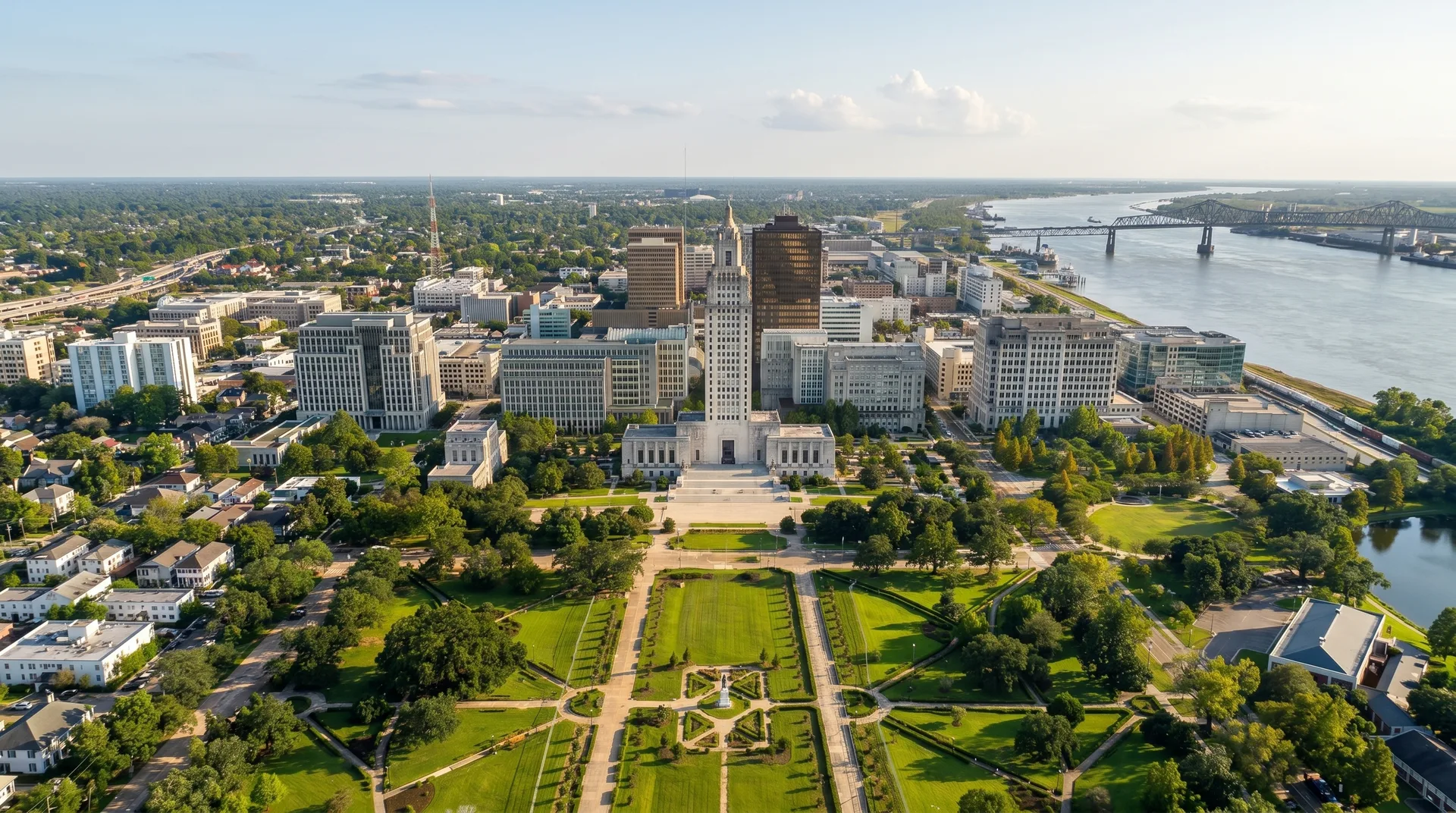

FTL freight in these cities of Louisiana
Ground freight transportation in Louisiana: strategic gateway to the Gulf of Mexico
Louisiana occupies a unique position in the North American logistics system as a convergence point between Gulf of Mexico maritime shipping, Mississippi River inland waterway navigation, and highway networks connecting the southern United States with Mexico. Home to the largest port complex in the Western Hemisphere by tonnage and an economy dominated by high-logistics-intensity industries, Louisiana generates specialized ground freight demands and significant volumes. At Control Terrestre, we operate in Louisiana with FTL solutions designed for the specific characteristics of its industrial corridors and strategic connections.
The combination of world-class port infrastructure, proximity to oil and gas reserves, massive petrochemical processing capacity, and productive agriculture makes Louisiana a state where diverse cargo flows converge. Companies operating in Louisiana require logistics services that understand both the technical requirements of specialized industries and the operational dynamics of large-scale ports and dispersed industrial zones.
Infrastructure and connectivity
Louisiana's interstate highway system connects the state to the rest of North America. Interstate 10 crosses Louisiana from east to west, connecting New Orleans with Baton Rouge, Lafayette, and Lake Charles, continuing toward Texas and Florida. This primary artery handles massive cargo flows related to the state's petrochemical, port, and manufacturing industries.
Interstate 20 crosses northern Louisiana, connecting Shreveport with Monroe and continuing toward Texas and the southeastern states. Interstate 49 runs north to south, linking Shreveport with Alexandria and Lafayette, providing access to the state's central areas. Interstate 55 connects the Hammond area with Mississippi, facilitating movements toward Memphis and northern states.
The Port of South Louisiana, stretching along 54 miles of the Mississippi River between New Orleans and Baton Rouge, is the highest-tonnage port in the Western Hemisphere. Specializing in bulk commodities (grain, coal, petroleum, chemicals), it serves as a critical hub for U.S. agricultural exports and energy imports. The Port of New Orleans handles containers, general cargo, coffee, steel, and multiple commodities, with direct connections to Central and South America.
The ports of Baton Rouge, Lake Charles, and Shreveport-Bossier add specialized capacity for petrochemical products, petroleum refined products, and bulk cargo. Navigation on the Mississippi River and the Gulf Intracoastal Waterway provides inland waterway transportation that complements ground options for heavy and bulk cargo.
Rail operations by Union Pacific, Kansas City Southern, BNSF, and Norfolk Southern connect Louisiana to national rail networks, facilitating long-distance intermodal movements, particularly relevant for chemicals and agricultural commodities.
Key industries and sectors
The petrochemical and refining industry dominates Louisiana's industrial landscape. The state is home to approximately 20% of U.S. petroleum refining capacity, with massive complexes concentrated in the area between New Orleans and Baton Rouge, known as "Cancer Alley" or the industrial corridor. The production of plastics, resins, organic and inorganic chemicals, fertilizers, and multiple petrochemical derivatives generates constant demand for specialized hazardous materials and chemical transportation.
The oil and gas sector includes both offshore extraction in the Gulf of Mexico and onshore operations. Logistics support for oil platforms and the distribution of specialized equipment require oversized cargo and specialized materials transportation. Liquefied natural gas (LNG) processing at export terminals adds logistical complexity.
Louisiana's agriculture produces rice, sugarcane, soybeans, cotton, and forest products. The state is a national leader in crawfish production and has a significant fishing industry. Grain exports through Mississippi River ports generate inland cargo flows from the country's interior to port terminals.
The processed food industry includes seafood processing, sugar refining, rice milling, and Cajun and Creole food production. The movement of perishable products requires reliable refrigerated transportation to regional and national markets.
The manufacturing sector encompasses shipbuilding and offshore construction, industrial equipment, wood and paper products. The presence of aerospace industry companies, particularly in New Orleans, generates specialized transportation requirements.
Port logistics is itself a significant industry. The handling of imports of coffee, cocoa, steel, natural rubber, and multiple commodities, along with exports of grain, chemicals, and machinery, generates massive inland redistribution cargo flows.
Our solutions for Louisiana
Control Terrestre operates in Louisiana with a deep understanding of the specific requirements of its core industries. Our full truckload (FTL) services connect Louisiana with Mexico, the rest of the United States, and Canada, facilitating continental supply chains.
For Louisiana's petrochemical and chemical industries, we provide specialized cargo services with capacity for materials requiring specific safety protocols. We work with carriers in our network that hold Responsible Care certifications and other relevant accreditations for handling chemicals and hazardous materials. Our specialized tank trailers handle industrial liquid transportation when operations require it.
Our import and export services coordinate ground transportation connected to the ports of South Louisiana, New Orleans, Baton Rouge, and Lake Charles. This capability facilitates movements from port terminals to inland destinations in the United States or Mexico, as well as from origins to export facilities.
For the food industry and agricultural products, we offer refrigerated transportation with 48' and 53' units to maintain strict cold chains. The movement of seafood, processed products, and other perishables requires rigorous temperature control that our units provide.
Our Full and Tandem dry vans handle general merchandise, manufactured products, construction materials, and packaged commodities. For companies with manufacturing or distribution operations and regular flows, dedicated services provide operational predictability between specific locations.
Expedited freight addresses urgent situations common in Louisiana's industrial operations, particularly when petrochemical or manufacturing plants require components or materials on critical timelines. Spot services offer flexibility for unscheduled needs or variations in production volumes.
Through our network, some carriers hold C-TPAT and FAST certifications, relevant for cross-border operations between Louisiana and Mexico. The Clean Transportation certification applies to companies with sustainability requirements in their supply chains.
Frequently asked questions
Does Control Terrestre handle chemical materials transportation from Louisiana?
Yes, through our specialized carrier network we handle materials requiring specific safety protocols. We work with partners that hold Responsible Care certifications and a deep understanding of the chemical sector's requirements. Our specialized cargo services include appropriate capacity depending on the type of material, complying with applicable regulations for chemical and hazardous materials transportation.
Can you coordinate movements from Louisiana ports to Mexico?
Indeed, our import and export services facilitate ground freight transportation for cargo arriving at Louisiana ports with final destination in Mexico. We coordinate movements from South Louisiana, New Orleans, Baton Rouge, or Lake Charles, handling the complete transit including the border crossing. This capability is relevant both for imports requiring redistribution in Mexico and for Mexican exports departing through Louisiana ports.
What solutions do you offer for the petrochemical industry along the New Orleans–Baton Rouge corridor?
For the petrochemical industrial corridor, we operate services that understand the sector's technical and safety requirements. Our specialized carriers handle chemical materials with appropriate protocols. Dedicated services are particularly useful for regular movements between production plants, storage facilities, and ports. We also coordinate transportation of specialized equipment and maintenance materials for industrial operations with unit configurations appropriate for the cargo type.


Freight experts
Ground freight from North to Central America with full coverage and 24/7 monitoring.








