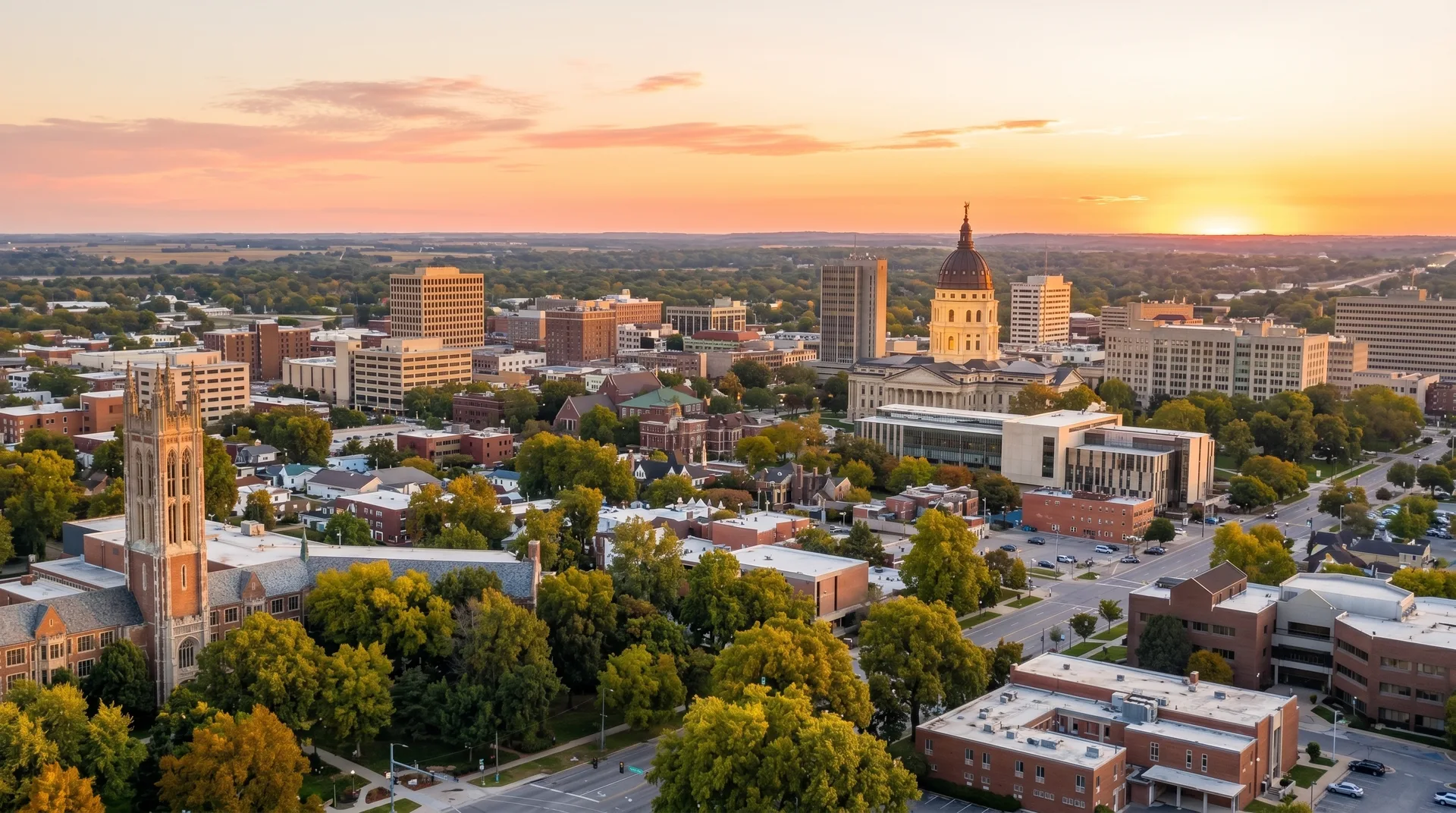

Ground freight transportation in Kansas: central hub for transcontinental commerce
Kansas is positioned at the exact geographic center of the continental United States, making it a natural convergence point for commerce flowing in all directions across the country. Its strategic location on the Great Plains and its world-class interstate transportation infrastructure establish it as a fundamental logistics corridor for transcontinental movements between the coasts, and as a distribution hub for companies seeking to reach national markets from a central position. At Control Terrestre, we operate daily in Kansas, moving full truckload (FTL) freight across the main corridors connecting Kansas City, Wichita, Topeka, Overland Park, and other key cities with the rest of North America.
Kansas's logistics ecosystem combines its agricultural heritage as a leading producer of wheat and cattle, with a diversified economy that includes the country's most important aerospace manufacturing, food processing, energy, and distribution logistics. This mix generates varied demands: from refrigerated transportation for meat and agricultural products, to specialized movements of precision aerospace components, to dedicated services for distribution centers serving the entire country. We operate in Kansas with a full understanding of these diverse needs, supported by a network of carriers with C-TPAT, Transporte Limpio, and sector-specific experience certifications.
Infrastructure and connectivity
Interstate 70 (I-70) is the primary east-west transportation artery in Kansas, being one of the most heavily traveled transcontinental routes in the United States. It crosses the state from east to west connecting Missouri with Colorado, passing through Kansas City, Topeka, Junction City, Salina, and Hays. This interstate handles massive volumes of freight crossing the country between the coasts, and is fundamental for virtually any transcontinental movement passing through the center of the country.
Interstate 35 crosses Kansas from north to south at its eastern edge, connecting Iowa with Oklahoma and continuing into Texas. This route passes through the Kansas City metropolitan area and cities such as Ottawa and Emporia, being vital for north-south commerce and for connecting Midwest markets with the Gulf of Mexico. Interstate 135 runs through the center of Kansas from north to south, connecting Salina with Wichita and continuing into Oklahoma, providing direct access to the state's aerospace region.
The Kansas Turnpike (I-335/I-470) connects Kansas City with Wichita passing through Topeka, being a toll route essential for high-speed traffic between these major cities. Federal highways such as US 56, US 54, and US 400 complement the interstate network, providing access to agricultural communities, processing plants, and industrial centers distributed throughout the state.
Kansas City (although the main city is in Missouri, the metropolitan area extends into Kansas) is one of the most important logistics hubs in the United States. This area concentrates millions of square feet of distribution centers, cross-docking facilities, and intermodal operations serving the entire country. The region is a critical rail hub and hosts world-class logistics infrastructure. Although Kansas does not have seaports, its central position and intermodal connectivity make it ideal for national distribution.
The Wichita Dwight D. Eisenhower National Airport handles air cargo operations, especially important for the aerospace industry. The Kansas City International Airport (mostly in Missouri but serving the region) is a significant hub for expedited freight.
Key industries and sectors
The aerospace industry is Kansas's most iconic manufacturing sector. Wichita is known as the "Air Capital of the United States," hosting operations from Spirit AeroSystems (one of the world's largest fuselage manufacturers), Textron Aviation (Cessna and Beechcraft), Bombardier, and multiple aerospace suppliers. This industry requires specialized transportation of precision components, aircraft structures, aerospace materials, and sensitive equipment with strict security protocols and complete traceability.
Agriculture remains fundamental to Kansas's economy. The state is the largest producer of wheat in the United States, in addition to being a leader in cattle, sorghum, and sunflower production. This output generates demand for grain transportation, agricultural inputs (seeds, fertilizers, chemicals), and intensive seasonal movements during harvests. The meat processing industry is equally important: Kansas is home to some of the country's largest beef processing plants, concentrated in cities such as Garden City, Dodge City, and Liberal. These facilities demand constant refrigerated transportation for meat products destined for national and international markets.
The energy sector has grown significantly, with Kansas being a major producer of oil and natural gas, and a leader in wind energy generation. The energy industry requires transportation of drilling equipment, wind turbine components (often oversized), pipelines, and hazardous materials. Logistics and distribution is an industry in itself in Kansas City, with multiple e-commerce, retail, and wholesale distribution companies operating regional or national centers leveraging the state's central position.
Diversified manufacturing includes production of agricultural machinery, industrial equipment, chemicals, processed foods, and consumer goods, generating constant demand for transportation of raw materials and finished products.
Our solutions for Kansas
At Control Terrestre, we offer full truckload services designed for Kansas's economic diversity and its role as a transcontinental corridor. Our domestic ground transportation services connect Kansas with all major markets: constant routes to California and the west coast via I-70, movements to Texas and the Gulf via I-35, connections to Chicago and the Midwest, and links to the east coast for national distribution.
We operate 48' and 53' dry vans (full and tandem) for general manufacturing movements, aerospace products (when dimensions allow), bagged grains, agricultural inputs, consumer goods, and virtually any type of general freight. These units handle both transcontinental traffic and regional distribution, and are available in full or tandem configurations depending on weight and load distribution requirements.
Our refrigerated transportation units in 48' and 53' (full and tandem) are essential for Kansas's meat industry. We maintain precise temperature control for beef, pork, poultry, and processed food products from processing plants to destinations across the United States. Our refrigerated carriers comply with food safety, biosecurity, and complete documentation protocols for traceability.
Dedicated services are especially valuable for companies with operations in Kansas that require guaranteed capacity. This includes recurring routes between aerospace plants in Wichita and customers in other regions, constant movements from meat processing plants to national distribution centers, or regular circuits from distribution centers in Kansas City to regional markets. Dedicated services provide predictability in capacity, schedules, and costs.
Our expedited freight services are critical for the aerospace industry and advanced manufacturing operating on just-in-time models. These services prioritize transit time to maintain production lines, respond to emergencies, or meet tight delivery windows. They are also useful for distribution companies requiring urgent replenishments.
We handle specialized freight for specific sectors. For the aerospace industry, we transport precision components with security protocols and careful handling. For the energy sector, we provide flatbeds for oversized equipment such as wind turbine blades, industrial structures, or heavy machinery. For hazardous materials related to energy or agriculture (chemicals, fertilizers, fuels), we work with carriers certified in Hazmat and Responsible Care.
We offer spot freight for one-time needs, useful during seasonal peaks in agriculture or when business opportunities arise requiring immediate capacity. Our carriers include operators with C-TPAT certifications for companies engaged in international trade, and operators certified in Transporte Limpio demonstrating a commitment to sustainability.
Frequently asked questions
Can Control Terrestre handle specialized transportation for the aerospace industry in Wichita?
Yes, we have experience moving aerospace components to and from Wichita. We work with carriers that understand the careful handling requirements, security protocols, and traceability demanded by this industry. Depending on the type of component, we use dry vans for parts that fit within standard dimensions, or flatbeds for larger structures such as fuselage sections. Our carriers comply with documentation protocols and can handle sensitive movements to the standards the aerospace industry requires.
What refrigerated transportation services are available for meat processing plants in Kansas?
We offer refrigerated transportation in 48' and 53' units (full and tandem) designed specifically for the meat industry. These units maintain temperature control from processing plants in Garden City, Dodge City, Liberal, and other locations to destinations across the United States. Our carriers comply with biosecurity protocols, equipment cleaning between loads, and complete documentation for traceability and food safety. We handle both long-haul national distribution and regional movements, and can structure dedicated services for companies with consistent volumes.
Does Control Terrestre offer services from distribution centers in Kansas City to other regions?
Absolutely. Kansas City is one of the most important logistics hubs where we operate constantly. We offer both spot freight for one-time movements and dedicated services for companies with recurring distribution needs. We handle movements from distribution centers in Kansas City to virtually any market in the United States: west coast, east coast, Midwest, south, and north. Our understanding of Kansas City's logistics infrastructure, facility protocols, and best outbound routes to different regions allows us to optimize operations and provide reliable service.


Freight experts
Ground freight from North to Central America with full coverage and 24/7 monitoring.








